Sabre IUR integration

Sabre IUR Integration with SYSTACC for Travel Agencies

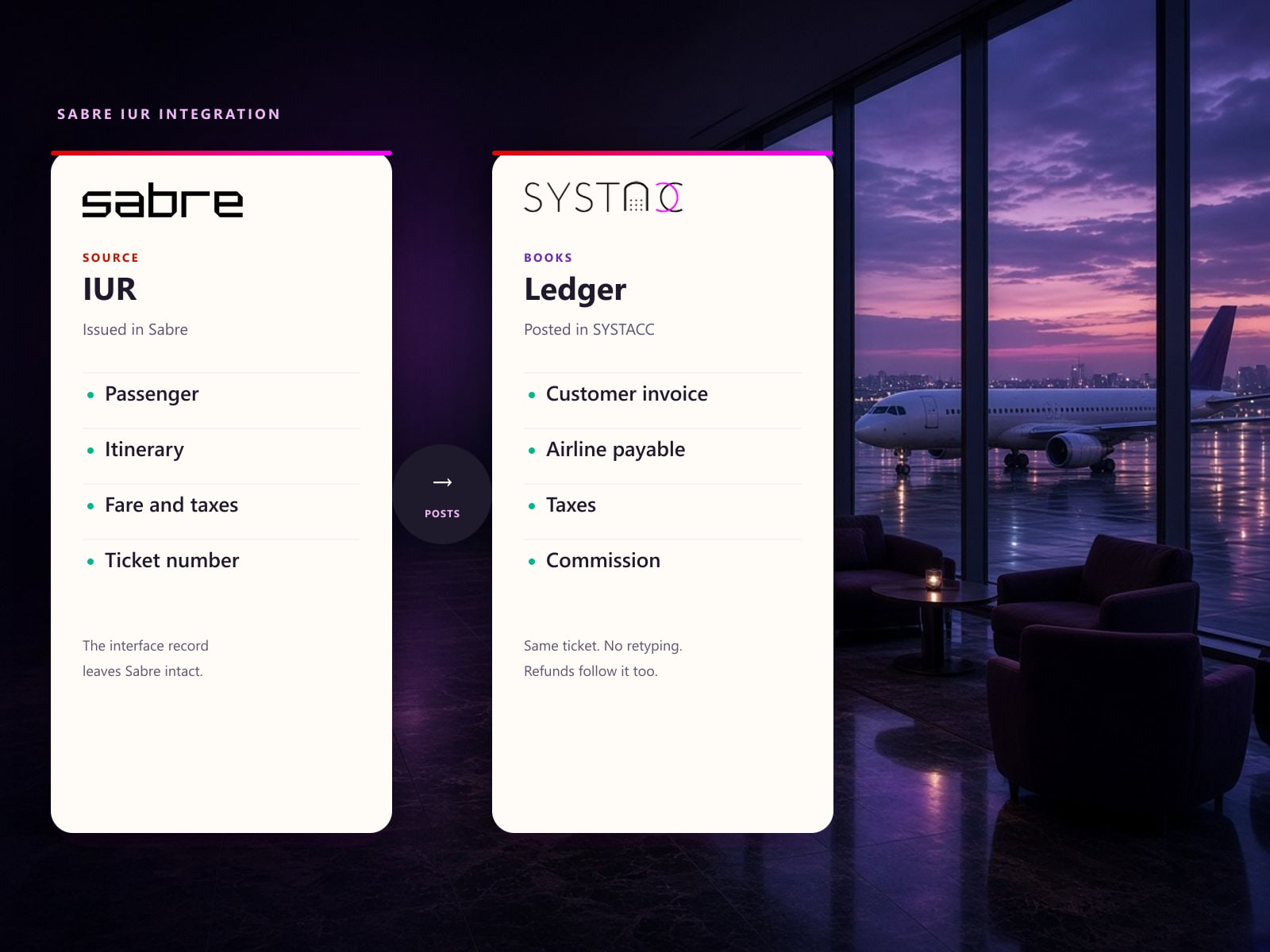
Ticket on Sabre, and the IUR already holds the passenger, the itinerary and the ticket number. SYSTACC posts that record as the customer invoice and the airline payable, with taxes and commission on the same line.

ExchangesPartial refundsFare in another currencyNo original ticket
Sabre IUR posting passenger, itinerary, fare and ticket number into the SYSTACC ledger as invoice, payable, taxes and commission.
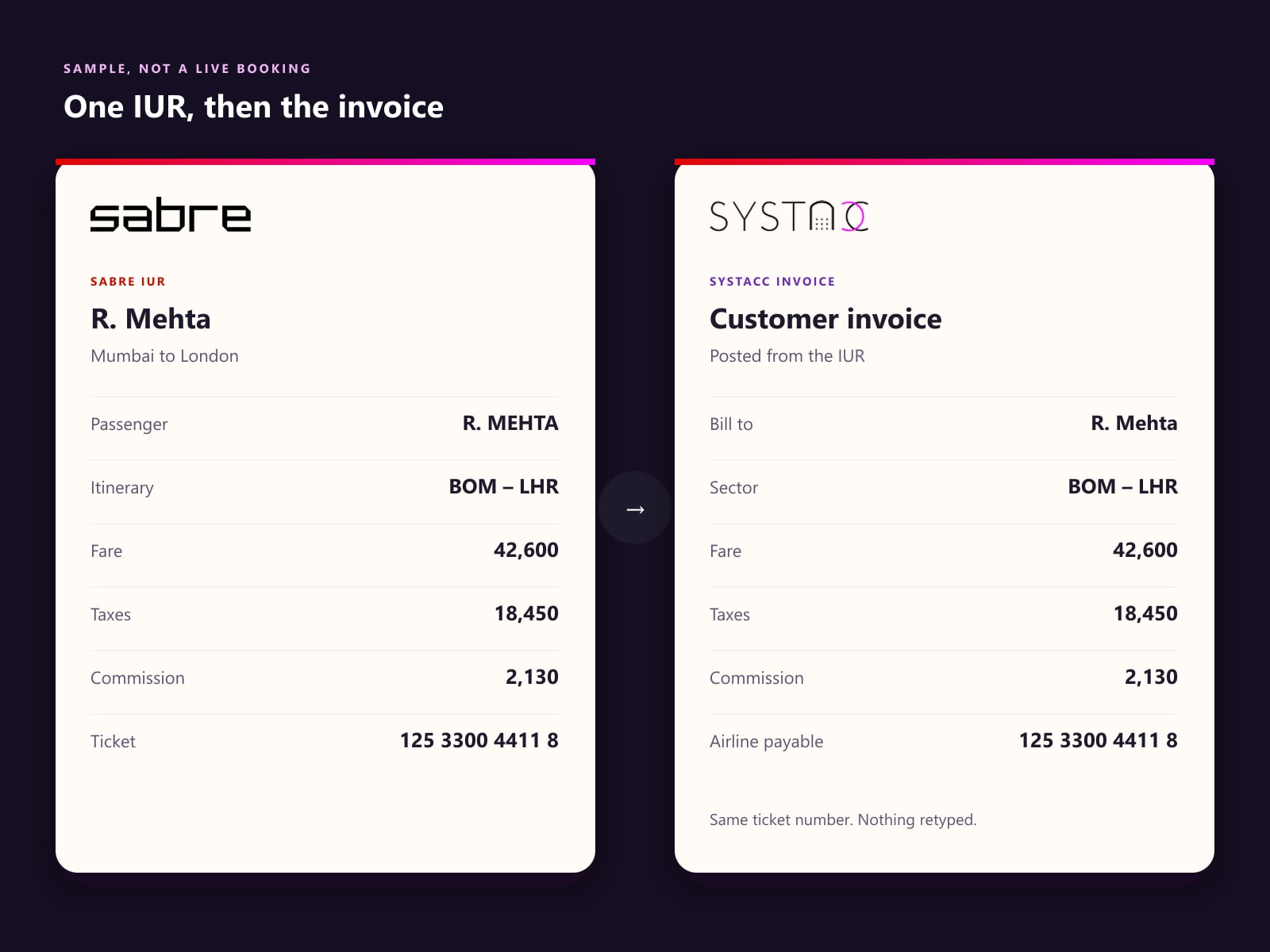
Sample Sabre IUR for R. Mehta, Mumbai to London, beside the SYSTACC customer invoice posted from the same fare, taxes, commission and ticket number.

Overview

Accounting software built for travel

Sabre is the screen a lot of agencies still sell on, because search, booking and ticketing stay in one place. In 2025 Sabre reported 308.5 million air distribution bookings, after 307.5 million in 2024. Those counts are from Sabre’s full-year 2025 earnings release. They are air bookings through Sabre’s distribution business, net of cancellations.

The file accounts needs is the IUR, the interface user record Sabre sends to the back office when a ticket is issued. It carries the passenger, the itinerary, the fare, the taxes, the commission and the ticket number.

The documents beside this section are a sample built from those fields. Passenger R. Mehta, Mumbai to London. The IUR shows fare 42,600, taxes 18,450, commission 2,130 and ticket 125 3300 4411 8. SYSTACC posts the customer invoice for that sector, and the airline payable uses the same ticket number.

A void, a refund or an exchange arrives as a later IUR and is matched to that ticket. An exchange, a partial refund, a fare in another currency, and a change with no original ticket are set out further down.

Benefits

What the IUR takes off the desk

01

Six fields stay on the file

Passenger, itinerary, fare, taxes, commission and ticket number move from the IUR onto the invoice. Those are the fields the desk stops retyping. SYSTACC has not published a minutes-per-ticket figure, so none is quoted here.

02

Invoice and payable together

The customer invoice and the airline payable are raised from the same IUR, with taxes and commission already split.

03

BSP is the airline settlement

BSP, IATA’s Billing and Settlement Plan, is the single billing statement and remittance an accredited agency uses with participating airlines. Sales, refunds and memos are matched on the ticket number, and the close is the lines that do not agree. The walkthrough is the BSP reconciliation guide.

04

GSTR-1 is the outward-supplies return

GSTR-1 is the GST return that reports what the agency supplied, including B2B, B2C and credit notes. The outputs are prepared from these transactions, and the airline amount stays apart from the agency’s own charges. Ticket GST is covered in the GST on air tickets guide.

How it works

From onboarding to daily books

  1. 01

    Connect the issuing office once

    Each office and pseudo city code that should send IUR records is set up once. After that, SYSTACC can collect new files on a schedule over FTP.

  2. 02

    Sell in Sabre as usual

    Booking and ticketing stay on the screens the desk already uses.

  3. 03

    The ticket posts

    SYSTACC reads the IUR and raises the customer invoice and the airline payable, with taxes and commission on the line.

  4. 04

    Later changes follow that ticket

    A void, a partial refund or an exchange in a later file is matched to the original document. The amount on that file is what posts.

  5. 05

    Accounts checks the exceptions

    A fare that does not tie, or a refund with no original ticket, stays visible for review.

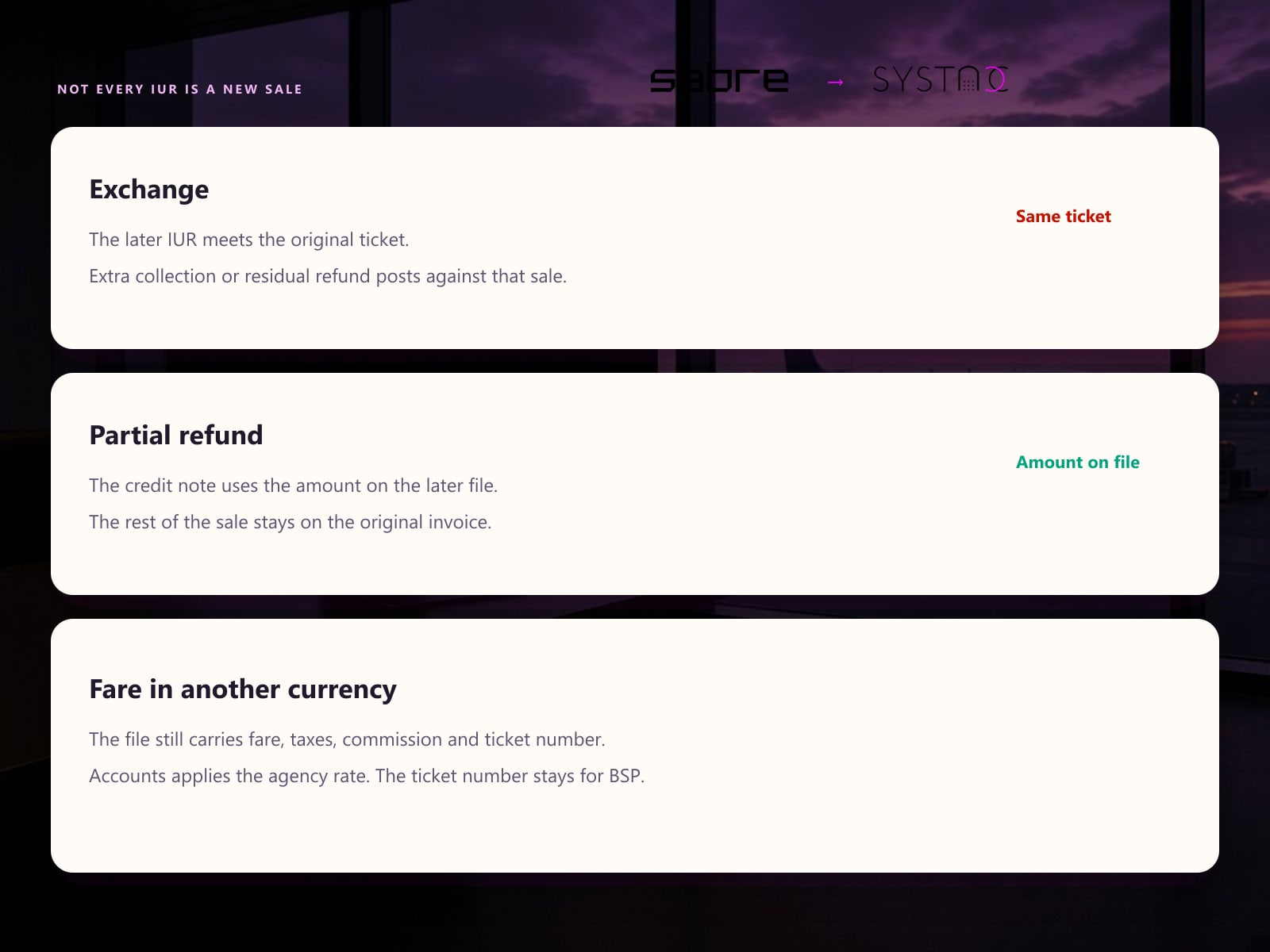
Sabre to SYSTACC edge cases: an exchange on the same ticket, a partial refund for the amount on the later IUR, and a fare in another currency.

Built with SYSTACC

Exchanges, partial refunds, and other fares

Exchanges

A later IUR for an exchange is matched to the ticket it replaces. An extra collection, or a refund of the difference, posts against that sale.

Partial refunds

When the later file refunds only part of the fare, the credit note uses that amount. The remainder of the original sale stays on the invoice, under the same ticket number.

Fare in another currency

The IUR can show the fare in the currency of the ticket. SYSTACC posts the passenger, fare, taxes, commission and ticket number from that record. If the books are kept in a different currency, accounts applies the agency’s own rate to those figures. The ticket number stays, so the BSP line can still be matched.

No original ticket

A void or refund whose file does not match a ticket already on the books stays in the exception list. It is left for accounts to place.

FAQs

Common questions

Does SYSTACC integrate with Sabre?

Yes. SYSTACC reads Sabre IUR records and posts each ticket as an accounting entry with the passenger, sector, fare, taxes and commission.

What is a Sabre IUR?

An IUR, or interface user record, is the record Sabre sends to the agency back office when a ticket is issued, voided, refunded or exchanged. It carries the ticket number, passenger, itinerary, fare, taxes and commission. The file formats are explained in the AIR, MIR and IUR guide.

Do we retype Sabre tickets into the books?

Tickets that arrive in the IUR are posted from that file. The fields that move across are the passenger, itinerary, fare, taxes, commission and ticket number. The team reviews the lines SYSTACC flags.

How are Sabre refunds, partial refunds and exchanges accounted for?

The later IUR is matched to the original ticket. A partial refund raises a credit note for the amount on that file, and the rest of the sale stays on the invoice. An exchange posts any extra collection or residual refund against the same sale.

What if the fare is in another currency?

The IUR can carry the fare in the currency of the ticket, and SYSTACC posts the fare, taxes, commission and ticket number from that record. If the books use a different currency, accounts applies the agency’s rate. The ticket number stays for the BSP match.

What is BSP?

BSP, IATA’s Billing and Settlement Plan, is the single billing statement and remittance an accredited agency uses with participating airlines. SYSTACC matches sales, refunds and memos on the ticket number. The steps are in the BSP reconciliation guide.

What is GSTR-1 in this flow?

GSTR-1 is the GST return that reports the agency’s outward supplies, including B2B, B2C and credit notes. SYSTACC prepares those outputs from the same transactions, with the airline amount kept apart from the agency’s own charges. See the GST on air tickets guide.

Can we use Sabre with Amadeus or Travelport?

Yes. Sabre, Amadeus and Travelport records post into the same accounting flow, so a mixed-GDS office keeps one ledger.

How does the IUR reach SYSTACC?

Sabre delivers the record to the agency, often to a folder or server. SYSTACC can pick those files up on a schedule through FTP sync.

Where do the Sabre booking figures come from?

The 308.5 million figure for 2025, and 307.5 million for 2024, are air distribution bookings from Sabre’s full-year 2025 earnings release. They count air bookings through Sabre’s distribution business, net of cancellations.

Related pages

Explore more accounting topics

A live walkthrough

Books that keep pace with every ticket, refund and rupee.

Thirty minutes on the calendar. We follow a booking through to the books, and you choose the time.

  • 30 minutes
  • Live product
  • Your operation
Prefer a written quote? Request pricing
CalendlySchedule a demoPick a time. We’ll bring the product.Open the calendar
Sabre IUR Integration with SYSTACC | SYSTACC